Fifty Forests, by Los Angeles–based American painter Kristin Leachman, explores pattern and symbolism in the growth formations of trees across all fifty U.S. states.

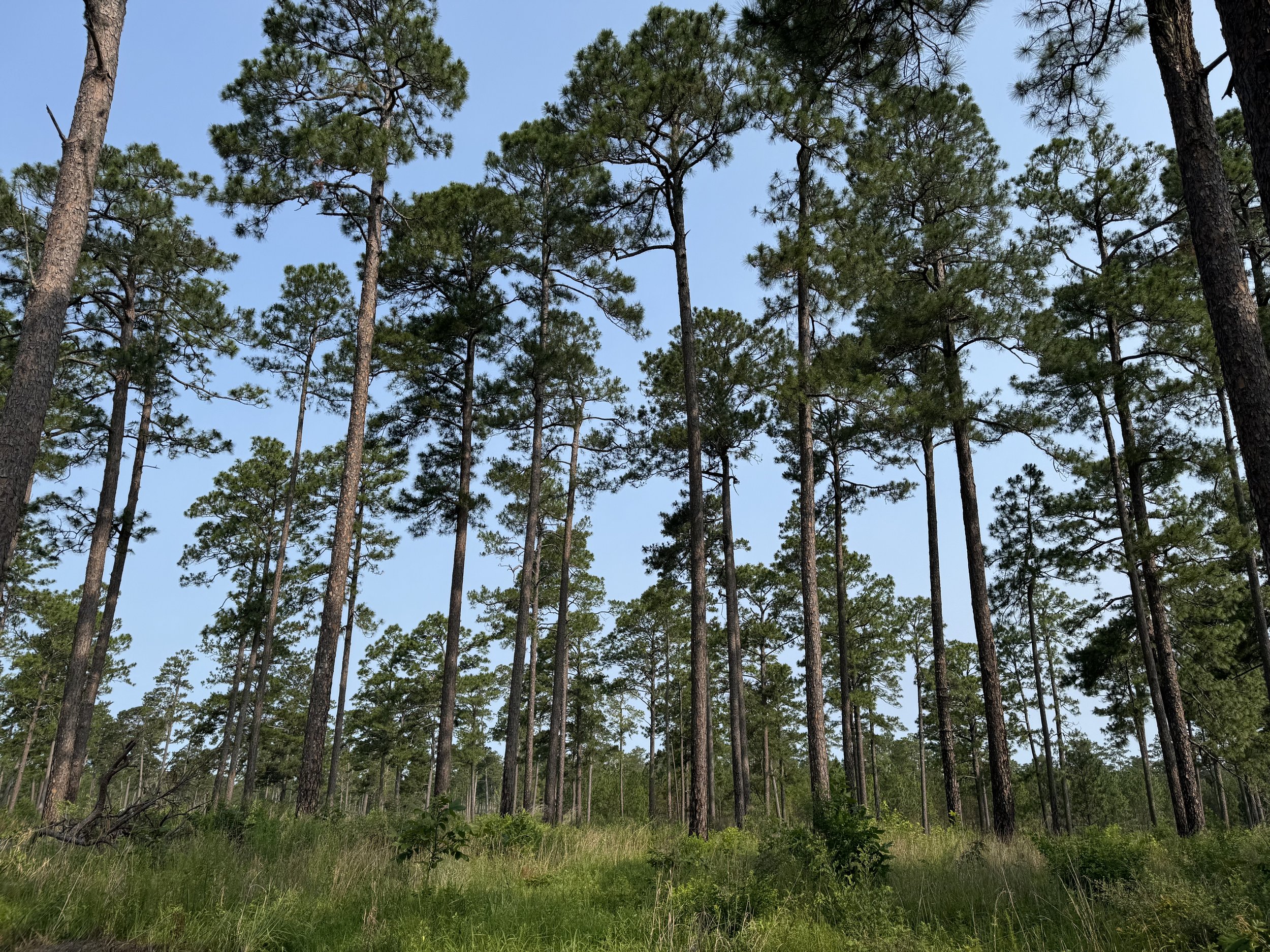
Longleaf Pine Forest, South Carolina
South Carolina
In 2025, I conducted fieldwork in a Longleaf Pine forest on a 23,000-acre South Carolina plantation, a site studied by Harvard archaeologists for Indigenous mound sites and Cornell ornithologists for its remarkable bird diversity. I am developing a series of paintings inspired by the abstracted forms revealed in old-growth pine bark following controlled burns. Through my practice, I continue to investigate the underlying architecture of the natural world, structures that are both visual and conceptual, and how these patterns reflect the ways we live, adapt, and connect. My aim is not merely to depict the landscape but to be in dialogue with it, listening to its rhythms, intelligence, and deep history.
Longleaf 7 / (Longleaf Pine, South Carolina), 54 x 72 x 2 inches, oil on canvas on panel, 2025. Private Collection.
Longleaf 8 / (Longleaf Pine, South Carolina), 54 × 72 × 2 inches, oil on canvas on panel, 2026. Private Collection.
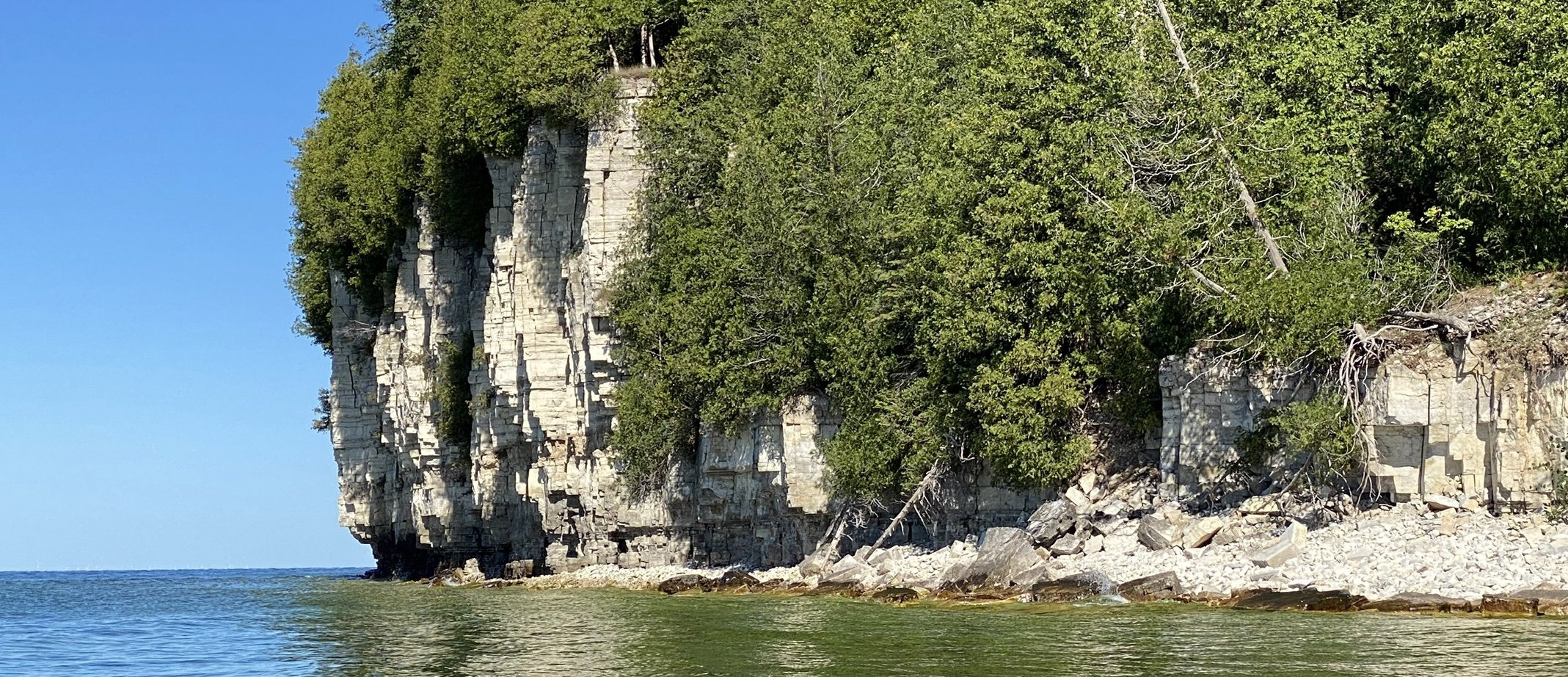
Ancient White Cedar Forest / Niagara Escarpment, Lake Michigan, Wisconsin.
Wisconsin
Wisconsin’s Ancient White Cedars are the oldest trees and forests in Eastern North America. My paintings for Wisconsin focus on the Cedar’s relationship with the Niagara Escarpment, a vertical ecosystem that has preserved these trees for over 1300 years. I conducted the research by kayak, paddling to Islands in Lake Michigan off the Door County Peninsula, to areas where the Escarpment reaches heights of 200 feet. The Cedar forests perch on the upper edges, pushing roots down through the rock strata. The escarpment was formed by the ice age and gives a glimpse into how our planet was formed. Understanding it and the trees’ survival requires stepping back to the Silurian period 430 million years ago, when a vast inland sea encompassed parts of northern Wisconsin. The escarpment is the shoreline of that ancient sea. It formed a snaking line of cliffs hundreds of miles long and its cliff dwelling trees are now among the world’s oldest organisms.
White Cedar 1 / (Ancient White Cedar and Niagara Escarpment, Lake Michigan, Wisconsin), 54 x 72 x 2 inches, oil on canvas on panel, 2025.
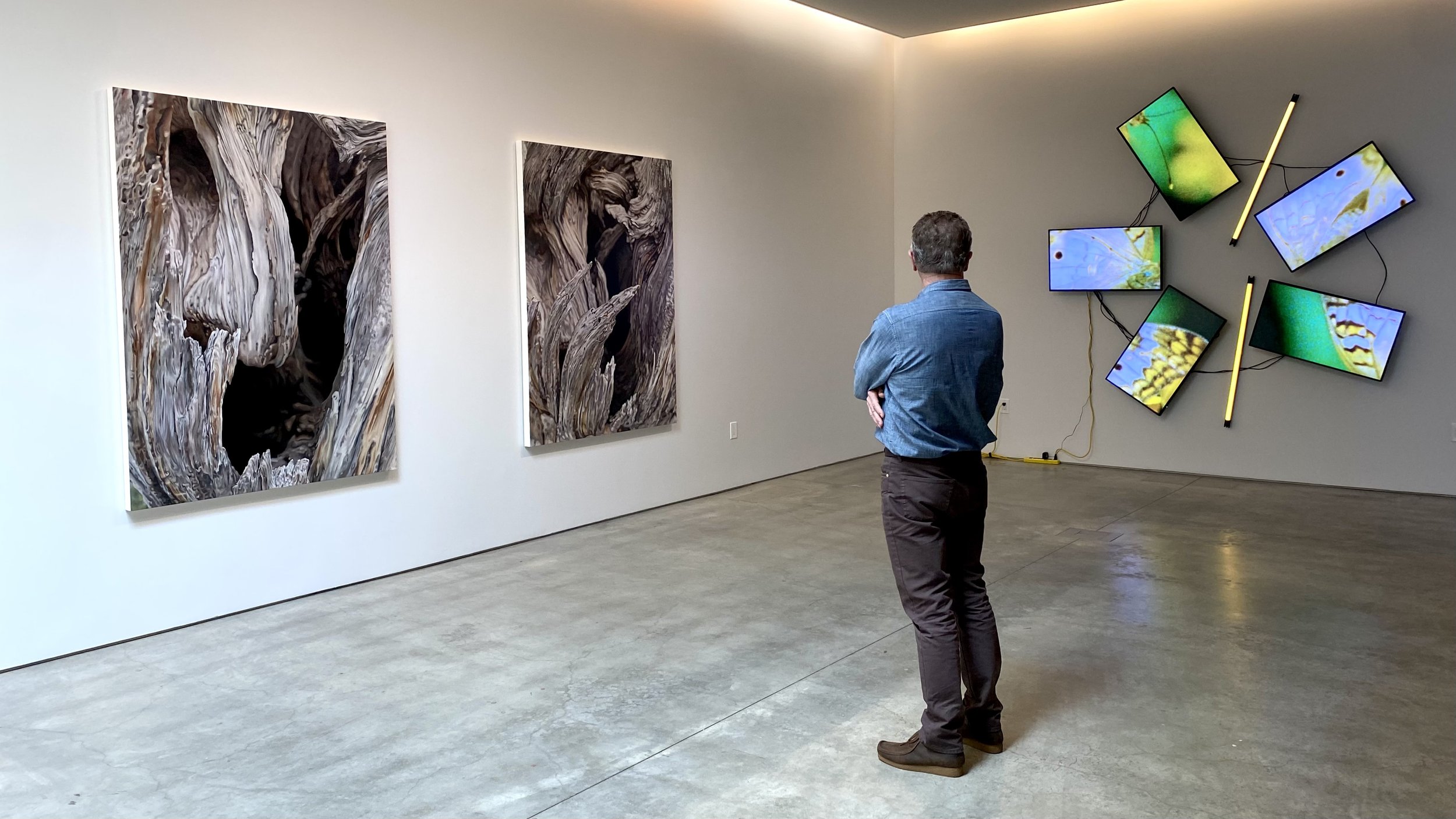
Group Exhibition: Zero Horizon ~ Art of The Forest Floor, Sturt Haaga Gallery, Los Angeles, California, 2023.
Montana
Montana’s Whitebark Pine trees, an endangered keystone species, are the current focus of my ongoing project, Fifty Forests. The paintings are based on research I did in three areas of Montana. The Lolo National Forest, where I hiked with a member of the Missoula based Rocky Mountain Research Center; the Flathead Reservation where I was guided by a tribal elder up a steep mountain, to explore a 600 year old sacred Whitebark Pine tree used by the Salish & Kootenai tribes for ceremonial purposes; and Glacier National Park where I conducted research in an ancient Whitebark stand in an area of the park sacred to the Blackfeet. Two Whitebark Pine paintings will be included in a group exhibition, Zero Horizon Art of the Forest Floor, at the Sturt Haaga Gallery, Los Angeles, California, June 17 - August 27, 2023.
Whitebark 1 / (Whitebark Pine, Two Medicine, Glacier National Park, MT.), 72 x 54 x 2 inches, oil on canvas on panel, 2023.
Whitebark 2 / (Whitebark Pine, Two medicine, Glacier National Park, MT.), 72 x 54 x 2 inches, oil on canvas on panel, 2023. Private Collection.
Whitebark 3 / (Whitebark Pine, Flathead Reservation, Polson, MT.), 72 x 54 x 2 inches, oil on canvas on panel, 2023. Private Collection.

Kristin Leachman: Longleaf Lines, Georgia Museum of Art, 2022 - 2023.
Georgia
Longleaf Lines
In June 2020, artist Kristin Leachman traveled to an old-growth longleaf pine forest in southwest Georgia. Longleaf forests are one of the most biologically rich ecosystems in the world, second only to tropical rainforests; however, today these forests primarily grow on private lands and are largely unfamiliar to the general public.
Through their scale and intimacy, Leachman’s paintings collapse this sense of distance and offer viewers a physically immersive experience. Focused on the longleaf’s bark formations, her works enlarge these patterns into monumentally scaled biomorphic abstractions. Capturing the tree’s marvelously scaly and fire-resistant surface, Leachman’s pictures also appear singed with fire. This effect points to the destructive histories of these landscapes. Longleaf once spanned 90 million acres across the southern United States, but declined to just 3 million acres after centuries of harvesting for ship masts, railroad ties and turpentine farming. These forests would have been cleared entirely for development had it not been for quail hunting, which became popular in the 1800s.
The scorched surfaces of Leachman’s pictures also correspond with the practice of regular burn cycles that foresters now use to maintain the longleaf ecosystem. As both a ravaging and refining force, fire is a fitting metaphor for the revitalized forests of longleaf pine, which today rise phoenix-like from the ashes. “Longleaf Lines” represents part two of Leachman’s “Fifty Forests Project”, which she began in 2010 in her adopted home state of California to document the self-organizing patterns in trees. The project is taking Leachman to various forested and deforested sites, protected and unprotected lands, in each of the 50 U.S. states. By transcribing the unspoken language of trees’ structural integrity and biological resilience, Leachman explores the intersection of painting and the natural world. “Fifty Forests” also reflects upon the relationship between humans and trees. What is at stake, Leachman’s paintings ask, as our country continually struggles to reconcile its connection to nature with its extractive use of natural resources?
– Jeffrey Richmond-Moll, Curator of American Art, Georgia Museum of Art, 2022.
Longleaf 1 / (Longleaf Pine, South Georgia.), 54 x 72 x 2 inches, oil on canvas on panel, 2020. Private collection.
Longleaf 2 / (Longleaf Pine, South Georgia), 54 x 72 x 2 inches, oil on canvas on panel, 2021. Collection of The Georgia Museum of Art.
Longleaf 3 / (Longleaf Pine, South Georgia), 54 x 72 x 2, oil on canvas on panel, 2021. Private Collection.
Longleaf 4 / (Longleaf Pine, South Georgia), 21 x 28 x 2 inches, oil on canvas on panel, 2022.
Longleaf 5 / (Longleaf Pine, South Georgia), 21 x 28 x 2 inches, oil on canvas on panel, 2022. Private Collection.
Longleaf 6 / (Longleaf Pine, South Georgia), 21 x 28 x 2 inches, oil on canvas on panel, 2022. Private Collection.

Kristin Leachman: Xylem Rays, Laguna Art Museum, CA, 2017
California
Xylem Rays
In my series Xylem Rays, I paint the self-organizing patterns that emerge from trees’ vascular tissue, known as xylem. The Xylem Rays paintings require prolonged visits to forest lands and sustained periods of reflection and study in my studio. Informed by both my own metaphysical connection to and physical dependence upon nature, I make nearly photorealistic representational paintings of xylem that, due to the inherent formal characteristics of their subjects, read like biomorphic abstractions. Together, the paintings in the Xylem Rays series depict the natural history of the landscapes from which they emerge, written in the unspoken language of the structural integrity and biological resilience of trees.
Xylem 14 / (Black Oak, Sierra Nevada Mountains, California), 48 x 60 x 2 inches, oil on linen, 2020. Private Collection.
Xylem 13 / Ode to a Grizzly (Black Oak, Yosemite National Park, Sierra Nevada Mountains, CA.), 60 x 80 x 2 inches, oil on canvas on panel, 2018.
Xylem 12 / Deer White Bison (Coastal Live Oak , Lower Arroyo Seco, Pasadena, CA.) 60 x 80 x 2 inches, oil on canvas on panel, 2016. Collection of Laguna Art Museum, CA.
Xylem 10 / Ode to a Mountain Lion / P-22 (Canyon Live Oak, Los Padres National Forest, CA.) 60 x 80 x 2 inches, oil on canvas on panel, 2016.
Xylem 8 / (Coastal Live Oak, Lower Arroyo Seco, CA.) 60 x 80 x 2 inches, oil on canvas on panel, 2014.
Xylem 7 / (Coastal Live Oak, Eaton Canyon, San Gabriel Mountains, CA.) 60 x 80 x 2 inches, oil on canvas on panel, 2014.
Xylem 3 / (Coastal Live Oak, Eaton Canyon, San Gabriel Mountains, CA.) 60 x 80 x 2 inches, oil on canvas on panel, 2012.
Xylem 2 / (Coastal Live Oak, Eaton Canyon, Angeles National Park, Altadena, CA.), 60 x 80 x 2 inches, oil on canvas on panel, 2012.